
City of Secrets
Four Seasons Hotel Prague
A Three-Part Series, By Senior Travel Editor, Brandi Brower
Sadness settles in at the end of any worthwhile journey; “all good things must come to an end” rings true. My travels through Central Europe's Golden Triangle have been unforgettable, with just one stop remaining. After perfect days in Budapest and Vienna, rain is forecast for my final destination. I share my disappointment with a Czech fellow passenger, who reassures me that the weather will be ideal for my visit. The City of a Hundred Spires, with its splendid architecture, gains character from brooding clouds. The heavy sky will make the dramatic buildings of my last stop appear somber and romantic, adding mystery.
Prague
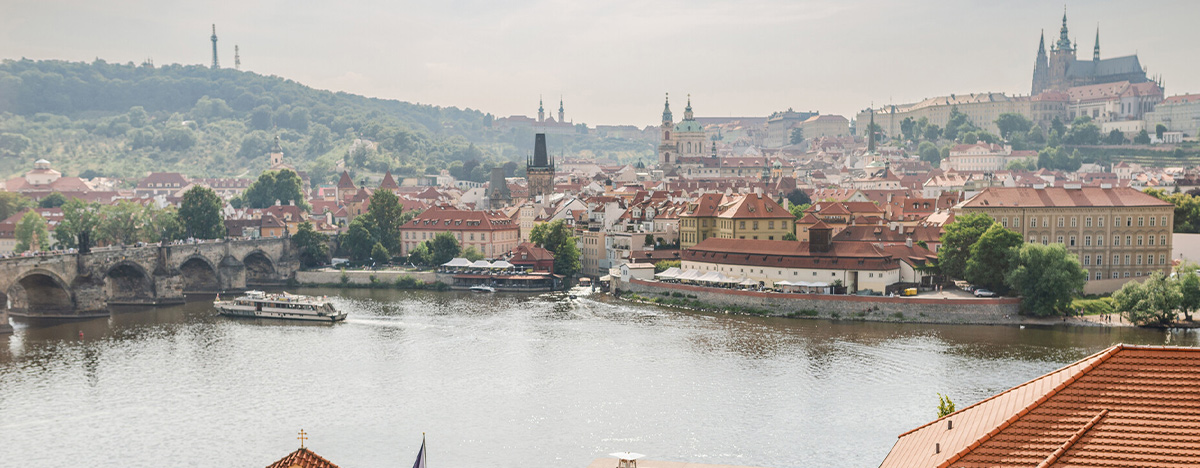
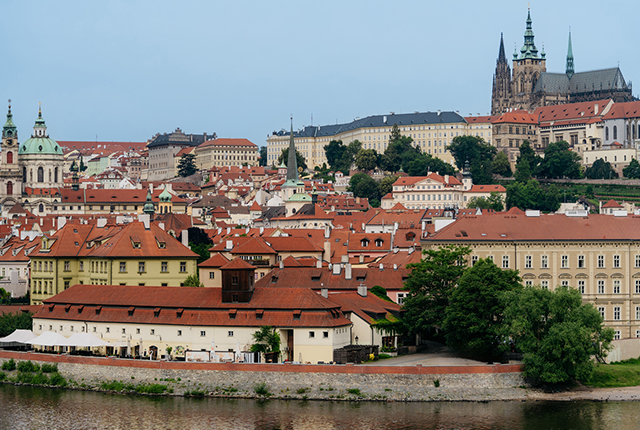
My cab ride from Prague’s station to the hotel is nondescript, but any doubts vanish upon arrival at the Four Seasons Hotel Prague. Here, location indeed matters: centrally placed in Old Town, on the Vltava River, overlooking Prague Castle, and near the Charles Bridge. This proximity is perfect for exploring an already walkable city.
The bellman assists me with my luggage and directs me to the reception. The striking floral arrangement in the lobby is the first clue I’m at a Four Seasons property, as it seems to be a signature style element for the brand. The energy is noticeable, soft voices and giggles signal that something is afoot. I soon learn that the excitement had just passed me by, literally. A well-known novelist whom I had barely missed seeing, Dan Brown. The best-selling author is famous for his mystery thrillers. One of them, The Da Vinci Code, became a cultural phenomenon, selling over 80 million copies, being translated into 44 languages, and consistently ranking among the best-selling books of all time. Yup, that Dan Brown. Timing in life is everything, and my timing was just seconds off. But my curiosity was intact, and I had to discover the mystery of the mystery writer’s residency at this posh Prague hotel.
Interest sparked, I quickly learn that the secretive stay is integral to The Secret of Secrets, the title of Dan Brown’s latest novel, which was being launched. Apparently, the Four Seasons Hotel provided exceptional accommodations for the lauded literary star. At the same time, he researched his latest project because the hotel was one of the book's central locations. Not only does the main fictional character, Robert Langdon, stay in the hotel’s lavish Royal Suite, but at a high-stakes moment in the book, he jumps out of the window of his hotel room into the Vltava River below. The author’s choice to use Prague’s mystique is intentional, combining the capital’s deep roots in alchemy, occultism, and dark legends with its carefully preserved Gothic and Baroque architecture and a sense of the supernatural within its haunting atmosphere. In many ways, the city itself appears as a character in its own right.
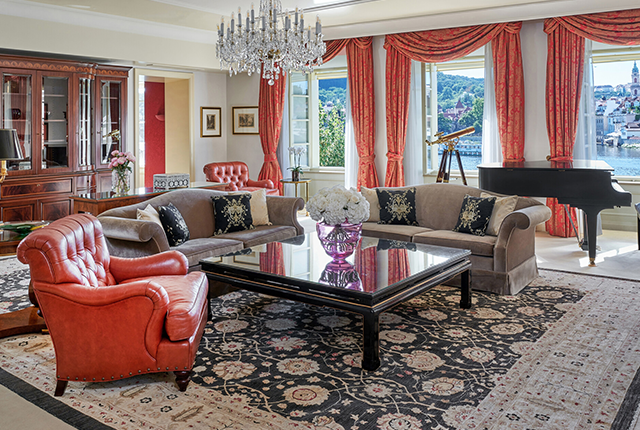
To truly appreciate the setting, I consider details about the protagonist’s Royal Suite, one of 19 exceptional quarters, this space features a fireplace, a dining room for eight, and a living room with a baby grand piano. It’s situated within the 16th-century Riverside villa portion of the hotel. The hotel has seven floors and 157 rooms, situated across three historic wings representing different architectural eras: Baroque, Neo-Classical, and Neo-Renaissance, dating back to the 18th century, as well as a modern building that blends these distinct structures, completed in 2001. While I may not be staying in the Royal Suite, my room is perfectly appointed. Upon entering, I’m impressed by the traditional Czech-style paneling and molding, hand-painted stenciling on the high ceiling, Bohemian crystal chandeliers, and huge windows decorated with thoughtful treatments. It feels like I’ve taken a trip back in time. A modern marble bathroom, including a soaking tub and a separate shower, rounds out the residential space, which is complemented by a beautiful light blue and celandine color scheme. On the desk, a sweet welcome gift, a chocolate clock tower, painted in gold, dare I say a confectionery clue. It’s patterned after Prague’s Astronomical Clock, just one of the many mystical must-sees during my stay.
“Every city has its secrets, but in Prague, they feel older than time itself... walking across the bridge, especially at either dusk or sunset, is like walking into a different era in time,” Dan Brown is quoted as saying. Not only does he consider the city to be the “mystical capital of Europe,” but his adoration continues, “I happen to think it is one of the - if not the most beautiful city in the world. It is just magical.” With the inspiration of the famed mystery author, I’m intent on uncovering and sharing all of the allure and secrets of this magical city.
At sunset, I walk from the hotel to the 14th-century Charles Bridge. In the square, a statue of King Charles IV, the educated, numerology-believing Bohemian king, stands tall. Royal astronomers advised him, using the palindrome number 135797531, to start the bridge’s construction at 5:31 am on July 9, 1357. Those numbers, carved into the Old Town Bridge Tower, are said to protect it. The medieval sandstone bridge, connecting Old Town and Lesser Town, is lined with 30 Baroque statues and spans a third of a mile, symbolizing Prague’s beauty and strength. Tonight, saints' statuary casts lengthy shadows from the gas lamps, and the rain’s mist, and the atmosphere is both mystical and chilling. I head for the hotel, planning to explore more by daylight.
After my evening walk, a meal at Cottocrudo, the hotel’s refined Italian restaurant and bar, is the perfect end to a long travel day. The rain has stopped, so I accept a patio table overlooking the glowing castle on the hill. After a savory amuse-bouche, Denys, the assistant manager, helps me choose dinner. I ordered burrata with stone fruit, followed by wagyu bolognese with fresh pasta, just delicious. Now, it’s time to make plans. The Four Seasons provides numerous experiences to enrich your stay in Prague, ranging from hiking excursions and day trips to learning about Bohemian Crystal or ringing the bell at St. Vitus Cathedral. With the concierge’s help, Anna arranges a private guided tour for the next day. Local knowledge will help me crack the code of this captivating city.
My sweet, mild server, Lucie, with a soft smile, pours freshly squeezed grapefruit juice after delivering my yogurt muesli and chocolate croissant. I will wake up earlier tomorrow to enjoy the breakfast buffet at Cottocrudo, but just a quick bite today. In the lobby, I meet Miriam, my tour guide. The Czech-raised, history major, is bright and witty and knows her Prague. We cross the Charles Bridge and the Lesser Town Bridge Tower, a monumental, gated entrance to Malá Strana (Lesser Town). This landmark offers panoramic views, features architectural styles from the past, and marks the entrance to the historic Royal Way. Lesser Town feels like the Harry Potter movies with its narrow, winding stone streets, moody gothic architecture, and, in particular, the historic, lantern-lit atmosphere of Nerudova Street. The street is known for its historic house symbols, such as the golden key or red eagle, used before modern numbering. A detail that is consistent with Dan Brown’s themes of codes, symbols, and hidden meanings in architecture. The area resembles a magical, centuries-old village; it feels like exploring Diagon Alley or Hogsmeade from the popular Harry Potter books, with the imposing Prague Castle as a backdrop that resembles Hogwarts itself.
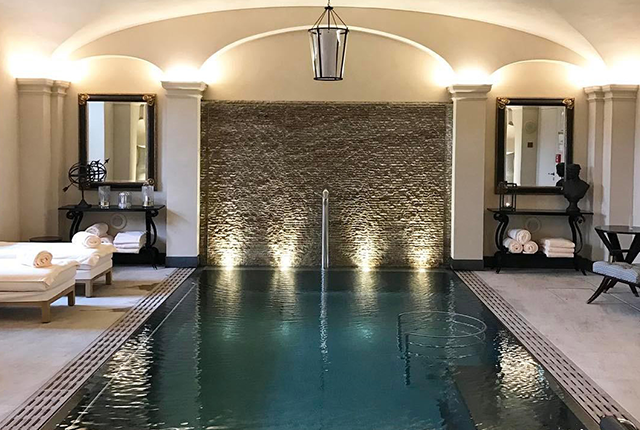
We catch a trolley up to the Strahov Monastery, take in an incredible view of the Prague districts, and the lay of the land to get our bearings before continuing. We move on to Prague Castle, the largest castle complex in the world, which you can easily spend days exploring just the castle grounds. Schwarzenberg Palace, St. Wenceslas Chapel, and St. Vitus Cathedral, which features the 14th-century Last Judgment located above the Golden Gate, is composed of approximately one million small glass tiles. Completed in 1371, this 1,000-square-foot artwork features over 30 shades of color in its impressive mosaic. Housed within the famous Cathedral is the 17-ton Sigismund Bell (Zikmund), the largest bell in the Czech Republic. Legend says that if the bell's clapper breaks, disaster follows, as happened before the 2002 floods that almost broke the Charles Bridge. It sounds like some Czech legends are true. Golden Lane, with its little colorful dwellings, each apartment depicting life from a different era, was the ghetto section of the castle grounds where the guards and servants used to live. Ending at the beautiful stained-glass Great South Tower and the Old Royal Palace, and viewing the rarely exhibited Bohemian Crown Jewels, was a happy accident while I was at Vladislav Hall. The exhibition shares the dramatic history of the jewels during World War II, and The Seven Locks: The reinforced door to the chamber requires seven different keys to be opened by the key holders, seven people in notable positions, including the President of the Czech Republic and the Archbishop of Prague.
Too much to see in one day, I arrange another tour with Miriam for the next morning, and we part ways. I meander the narrow streets of District 1, eyes constantly scanning the sky, absorbing the incredible architecture and detail, ending at Čertovka (the Devil's Channel), the famous 12th-century waterway, also known as Little Prague Venice, before climbing up stairs to the Charles Bridge to return to the comfort of the Four Seasons Hotel. Every site visited today is used in Brown’s book. It’s no mystery to me now why the popular writer chose this city of secrets as the perfect setting for his novel; this alluring capital has already captured my imagination.
The concierge suggests I walk to Staré Město (Old Town district) and enjoy a traditional Czech dinner. He gives me directions to Old Town Square, and I walk to the suggested Restaurace Mincovana. My waiter, Taras, is great at helping me decipher the menu and makes suggestions for a worthwhile first taste of this region’s cuisine. I was pleasantly satisfied with my choice of svickova na smetane (beef in cream sauce), a traditional Czech and Slovak dish. After dining, I take in a sneak peek of what’s ahead on tomorrow’s tour. Prague’s Old Town Square is a lively hub, where natives and tourists alike are buzzing, heading to the numerous cafes, restaurants, and bars that line the square and narrow, winding medieval side streets. But I’ve eaten, so my pace is slow and thoughtful as I cross the cobblestone surface, imagining steps taken by emperors, merchants, and artists, long ago. I admire the landmark buildings where floodlit Gothic and Baroque architecture creates a dramatic, fairy-tale atmosphere, a more peaceful preview of Prague’s historic Old Town Square.
Four Seasons Hotels and Resorts continually selects staff who enhance the hotel experience. Jana, a bubbly server with a great sense of humor, adds levity to the morning and lends proof to my theory. I’m seated at the window, overlooking the small tour boats on the river, gliding underneath the Charles Bridge. After taking another look at the incredible breakfast buffet, with its delicious hot and cold selections and perfect pastries, including the popular Kolaches, I am enticed. Still, I opt for French toast off the menu, which doesn’t disappoint. One can also argue that Four Seasons' food is an additional favored feature of the famed brand.
Miriam shared Josefov, the remaining preserved part of the Jewish Ghetto district, and the Old-New Synagogue, which is the oldest active synagogue in the world. According to 16th -century Jewish legend, Rabbi Judah Loew ben Bezalel created a clay giant, the Golem, to protect the community from persecution. The myth holds that the creature was created from clay taken from the banks of the Vltava River, and that its remains are still hidden in the attic of the Old-New Synagogue. This fabled character is reimagined within the pages of Secret of Secrets. A sobering moment, the Old Jewish Cemetery, among the oldest surviving Jewish burial grounds in the world. The oldest gravestone is that of a rabbi, dated 1439. There are around 100,000 bodies buried there, many of which were stacked 12 layers deep; as a result, the surface of the cemetery is raised many feet higher than the surface of the surrounding streets.
The Astronomical Clock, known as Orloj, is the most-visited place in Prague, attracting 700,000 visitors annually. Miriam shares that it's the oldest working clock in the world, with a mechanical mechanism dating back to 1410. She explains in detail how to read the clock, as well as the symbolism of the walk of the 12 disciples, and the four allegorical figures: Death, Vanity, Greed, and Lust, representing vices or medieval social fears, that all appear when the clock strikes. Orloj is prominently featured on the pages of Brown’s thriller; central to the mystery, the clock's real medieval and celestial symbolism is combined with a fictional conspiracy involving hidden messages and ancient mythology, acting as an entrance to Prague’s hidden, esoteric history.
The labyrinth of streets, transitioning between Old Town and New Town, walking through the old Gothic Powder Tower, built in 1475 as one of the 13 city gates, which was the starting point of the coronation procession of Bohemian kings, and now it's just two women making their way back to the hotel. We pass the Dvořák Hall, the gorgeous art nouveau concert hall, Wenceslas Square, the site of the 1989 Velvet Revolution protests that ended communist rule, ending at the Prague’s Klementinum, the Baroque library, a 17th century Jesuit hall housing over 20,000 theological volumes, antique globes, and an astrological tower which is a key setting for the protagonist Robert Langdon, depicted as a place of abandoned knowledge, bridging science, alchemy and mysticism. I feel the last two days I’ve been on a “Live Like Langdon” trail. With my head full of history and bohemian beauty, I bid my guide adieu and make my way back to the Four Seasons for some serious self-care at the AVA Spa.
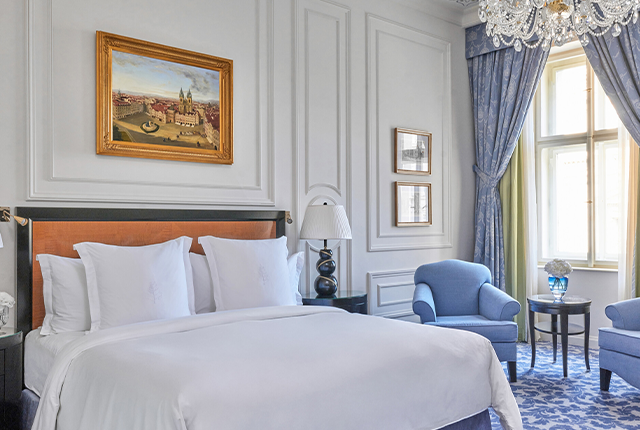
Mahsa, the lovely spa hostess, introduces me to the fabulous facilities, explaining that all the treatment rooms are named after Czech rivers, because water is healing. My indulgence begins in the steam room with eucalyptus to clear my passages, then moves to the dry sauna, and ends in the large spa room, where the vitality pool, at a perfect 91 degrees, features different sections of jets that stimulate various parts of the body, both invigorating and relaxing. The spa windows have a direct line of sight to the beautiful Prague Castle, where I gazed while sipping my tea, near the fireplace, wrapped in my Four Seasons robe, awaiting my therapist to pick me up. Denisa led me to the Svitava treatment room, where she skillfully performed the Alchemy Dream Ritual, one of the Czech Signature treatments. This ritual brings deep relaxation to tense muscles and nerves, removes blockages, and dissolves stress. After my treatment, the music felt ethereal, and the three chimes rang, indicating the conclusion of the experience. For a moment, I felt like I had died and was in heaven. Transcendent.
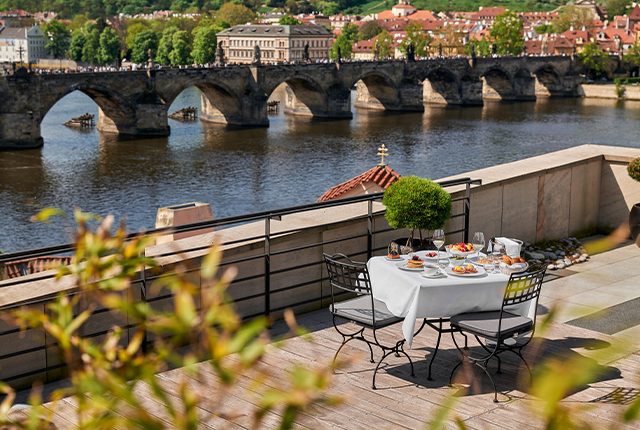
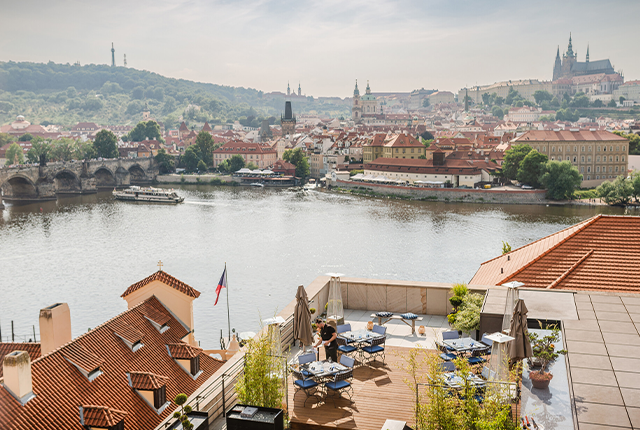
The rejuvenation of the phenomenal spa experience would be the ultimate highlight of the visit. Four Seasons had one more magical experience to mesmerize me with, MIRU. The seasonal pop-up Japanese restaurant is described as a “rare summer ritual” because it typically operates from late May through mid-September. As fate would have it, I was one of the lucky ones, favored to enjoy the flavors of MIRU on this evening. The exclusivity of the eatery, a highly intimate encounter featuring just four tables, is set on the hotel’s rooftop terrace, a transformed space inspired by a Japanese garden. You feel like you’ve been invited to a secret event, where a nine-course degustation menu, rooted in the Nikkei concept, which is the traditional Japanese techniques with a touch of Peruvian ingredients, is on full display. Blend the artistry of the cuisine, the privacy of the space, and the attentiveness of the staff, with the backdrop of the Prague skyline, that’s the secret of secrets.
I’m told to arrive at the rooftop at 6:00 p.m. sharp. Maria and Jaroslav will be attending to me for the evening. Oshiburi, a warm towel infused with lemongrass, is offered to prepare for the meal. A starter of edamame with a sprinkle of red pepper follows. Two sticky rice offerings are served before chutoro tartare, with caviar/wasabi soy and gold leaf. Sea bass usuzukuri, yuzu miso black cod, and wagyu tataki, followed by the nigiri selection of tuna truffle, creamy salmon, and sea-bream yuzu. My favorite dish of the night was the roasted turbot. A lovely palette cleanser: yuzu chantilly, coconut and lime granita with candied ginger; for dessert, jasmine cream, wasabi sponge, and pineapple vanilla compote with sake sorbet. You can enhance the dining experience with mindfully curated beverage pairings. I chose to soak in the incredible scenery as a complement to the meal. I was under the spell of the Prague skyline as the dinner was seamless from sunset until the moon appeared high above the castle spires. It being a four-hour gastronomic affair, I suggest it’s even sweeter when shared with another. Everything about this five-star luxury hotel would be sweeter when shared with another. I hope to return with the one I love.
During Dan Brown’s visit to Prague, when our paths almost crossed in the Four Seasons lobby, he declared his new novel a "love letter" to the city, calling it a captivating, historic, and romantic destination. He celebrated its ancient streets, stunning architecture, and deep mysteries, calling it a "companion" and “refuge.” Brown described Prague as a place where he left his heart, expressing that his love for the city deepens with every visit.
As I cross the Charles Bridge one last time before I catch my plane home, I overhear a tour guide instructing her travelers in front of a statue of St. John of Nepomuk. She tells her small crowd that rubbing the shiny bronze plaque at the base of the statue, which depicts his martyrdom, is believed to guarantee a return trip to the city and bring good luck.
Prague, the City of a Hundred Spires, is a breathtaking, well-preserved medieval gem on the Vltava River, with the blended beauty of Gothic, Baroque, and Renaissance architecture, and the blessing of surviving major wars. A wonderful walkable city with its dramatic castle views and fairy tale vibes, mysteries shrouded in centuries-old lore and legends, all wrapped in a mystical atmosphere. What an incredible city of secrets, I think to myself, as I reach out to rub the shiny bronze plaque. Not just for luck, but because I wish to come back.