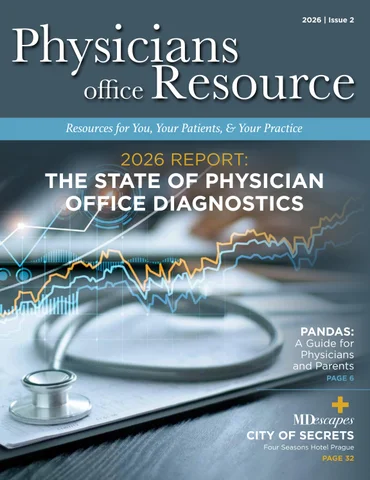
The State of Physician Office Diagnostics: 2026 Report
Friday, February 20, 2026
by Aaron Medaris
Physician office diagnostics are in the middle of a practical “reset” in 2026. The pandemic era normalized rapid, near-patient testing and raised expectations for convenience and speed. Now, the day-to-day reality is being shaped by a different mix of forces: workforce constraints, tighter margins, payer friction, evolving respiratory-virus guidance, and a growing demand to make care decisions in the exam room rather than “send-outs and wait.”
Across many specialties, but especially primary care, pediatrics, OBGYN, dermatology, and pain management, the common theme is the same: diagnostics are no longer an ancillary service—they’re a core operational capability. Practices that treat testing as a system (clinical pathways + workflow + quality + connectivity + reimbursement) are better positioned to improve patient experience, protect revenue, and reduce downstream leakage.
Below is a specialty-aware look at what’s changing—and what to prioritize—based on current guidance and policy signals heading into the 2025–2026 respiratory season and beyond.
- The 2026 physician-office diagnostic landscape: what’s driving change
Patients expect “answers today”
Consumer expectations now mirror urgent care and retail clinic norms: rapid answers, same-visit treatment decisions, and minimal follow-up friction. This is most visible in respiratory illness, STI evaluation, pregnancy-related concerns, UTI workups, and medication monitoring. This shift is one of the primary drivers behind expanded point-of-care testing menus and upgraded workflows designed to reduce callbacks and follow-ups.
Respiratory viruses remain the workflow stress test
The 2025–2026 season guidance continues to emphasize practical outpatient decision-making for influenza, COVID-19, and RSV—where testing can guide treatment, but therapy shouldn’t always wait for a result.
In practice, that means your testing menu and turnaround time (TAT) must match your clinical “decision window”—especially for higher-risk patients who benefit most from early antivirals.
Administrative burden pushes more “diagnostics at the point of decision”
Prior authorization and payer utilization management continue to pressure staffing and throughput. The American Medical Association’s prior authorization survey documents sustained burden and limited adoption of exemptions like “gold card” programs.
While PA is often discussed in imaging and specialty drug contexts, the operational response is broader: practices prefer diagnostics that reduce avoidable referrals, repeat visits, and delayed treatment.
CLIA compliance expectations are tightening back to “normal”
Post–public health emergency flexibilities are gone; Centers for Medicare & Medicaid Services communications underscore the return to pre-PHE requirements for starting testing (e.g., needing applicable fees and a CLIA number/certificate before testing). For offices expanding beyond waived testing, the compliance and inspection readiness burden is real—and must be planned.
- 2026 “must-have” diagnostic capabilities in primary care
Primary care remains the hub where a high volume of decisions benefit from rapid, reliable data. The most successful offices in 2026 are building a diagnostic footprint around five high-value categories:
Respiratory infection triage and treatment pathways
The question isn’t “Do we test?” but what we do with results, and how quickly.
What’s shifting:
- Outpatient guidance recognizes that a positive test isn’t always required to start antivirals for influenza or COVID-19, particularly when clinical suspicion is high and the patient is at risk for severe disease—yet testing can support appropriate treatment choices and stewardship.
- Practices increasingly want differentiation (flu vs COVID-19 vs RSV), because it affects antiviral use, isolation guidance, return-to-school/work counseling, and risk stratification.
Operational insight:
If your workflow can’t deliver a result within the visit (or in a timeframe that changes management), testing becomes “documentation” rather than decision support. In 2026, many offices are evaluating whether they need:
- Rapid antigen testing for immediate triage, plus
- Higher-sensitivity options (often molecular) for cases where false negatives are costly (high-risk patients, outbreaks, congregate settings, or when treatment hinges on confidence).
Cardiometabolic monitoring as “care velocity”
Diabetes, dyslipidemia, and kidney risk management depend on routine, repeatable monitoring. Offices that accelerate monitoring reduce gaps in care and strengthen quality performance.
Practical emphasis for 2026:
- Make sure your diagnostic cadence aligns with guideline-driven intervals (and your payer contracts).
- Close the loop: results reviewed, acted upon, documented, and communicated without delays.
Urinalysis, pregnancy testing, and basic microscopy decisions
Despite being “old school,” these tests remain high-impact for differential diagnosis and triage—especially in primary care and OBGYN.
FIT testing and preventive screening enablement
Even when the test is completed at home, the office’s role is diagnostic enablement: ordering, tracking, results capture, follow-up, and colonoscopy referral navigation.
Medication safety and monitoring
Point-of-care decisions around anticoagulation history, renal function considerations, and adherence counseling increasingly depend on having actionable data quickly (even if confirmatory testing is sent out).
- Pediatrics: fast answers, infection control, and family-centered decisions
Pediatrics is uniquely sensitive to household dynamics, school policies, and caregiver anxiety—making rapid diagnostics a clinical and communication tool.
2026 pediatric diagnostic priorities:
- Respiratory season playbooks: define when to test, when to treat, and when to reassure.
- Strep testing workflow (and follow-up culture/confirmatory strategy, depending on the method you use and local policies).
- Dehydration and UTI pathways: avoid missed diagnoses while minimizing unnecessary antibiotics.
Operational insight:
Peds offices benefit from “family flow” design—specimen collection that’s quick, predictable, and consistent, with scripts for what results mean (and don’t mean). In 2026, consistency is as valuable as technology.
4) OBGYN: accuracy, timeliness, and patient trust
OBGYN care frequently relies on diagnostics that carry immediate patient implications and require thoughtful counseling.
High-value focus areas:
- Pregnancy confirmation and early evaluation workflows.
- Vaginitis/STI testing pathways that balance speed, accuracy, and overtreatment risk.
- Prenatal screening coordination (where the office often manages timing, logistics, and follow-up—even for send-out assays).
Operational insight:
In OBGYN, the best diagnostic systems reduce “diagnostic limbo”—that waiting period where anxiety rises, phone calls increase, and follow-up adherence drops. Clear expected timelines, patient messaging, and electronic result capture matter as much as the test itself.
- Dermatology: diagnostics that prevent delays and repeat visits
Dermatology diagnostics in-office often revolve around rapid rule-outs and procedure-based confirmation.
Common diagnostic drivers:
- KOH preps and simple microscopy decisions (where used and supported by training).
- Biopsy workflows: specimen integrity, pathology partner performance, and result turnaround expectations.
- Acne and inflammatory disease monitoring: labs tied to medication safety and long-term management.
Operational insight:
Derm practices that treat diagnostics as a supply chain (collection → labeling → transport → pathology coordination → patient follow-up) reduce rework and reputational risk. In 2026, reliability is a competitive advantage.
- Pain management: monitoring, risk stratification, and documentation integrity
Pain management is documentation- and compliance-intensive, and diagnostics often function as part clinical tool, part risk-management tool.
Diagnostic considerations:
- Toxicology testing policies (including appropriate use, patient communication, and consistency).
- Comorbidity monitoring (renal/hepatic considerations, metabolic risk, and medication interactions).
- Clear documentation workflows to support medical necessity and minimize payer disputes.
Operational insight:
In pain management, diagnostic strategy should be policy-driven and transparent—patients do better when expectations are clear, consistent, and framed as safety and quality rather than suspicion.
- Quality, compliance, and the “CLIA reality check” for 2026
For many offices, the question is whether to remain primarily CLIA-waived or expand into moderate complexity. Each choice has consequences.
Key compliance signals to keep on your radar:
- CMS has emphasized that after the public health emergency, laboratories may only begin testing after they meet applicable requirements and receive their CLIA number/certificate—i.e., expedited COVID-era pathways are not the norm.
- Proficiency testing requirements remain a core operational obligation for many non-waived testing areas (and are updated annually).
Practical takeaway:
If you expand your in-office menu, don’t just budget for the instrument—budget for training, QC, documentation, competency assessment, proficiency testing, and inspection readiness.
- Reimbursement and operations: what “good” looks like now
Even with excellent clinical intent, diagnostics fail when operations break down. In 2026, high-performing practices build around these operational pillars:
- Clinical pathways first, test menu second
Start with: “What decisions do we make in-visit, same-day, 48 hours, and one week?”
Then align test methods and partners to those decision timelines.
- Staffing design and cross-training
Because turnover happens, resilience requires:
- Role-based checklists (collection, run, QC, documentation)
- Cross-training at least two people per testing workflow
- Simple competency refresh routines
- Connectivity and results capture
If results aren’t discrete-data captured, searchable, and reportable, you lose value:
- Quality reporting becomes harder
- Follow-up is inconsistent
- Population management suffers
- Patient communication as a diagnostic deliverable
“Your test is negative” is not enough. In 2026, patients want:
- What the result means
- What to watch for
- When to return
- Whether treatment is still recommended based on risk
- Administrative friction still matters
Prior authorization burden remains a significant operational drag in physician practices, consuming staff time and delaying care.
Diagnostics that reduce unnecessary downstream services—and support defensible documentation—help practices navigate this reality.
- The 2026–2027 outlook: where physician office diagnostics is headed
Expect three major trends to intensify:
- More “near-patient” decision support
Not every test becomes point-of-care, but more clinical choices will be made with immediate data—especially for respiratory illness and chronic disease touchpoints. - Higher expectations for performance and stewardship
As more advanced tests migrate closer to the patient, practices will face pressure to use them appropriately—avoiding unnecessary antibiotics, reducing repeat visits, and improving guideline adherence. - Operational excellence becomes the differentiator
The winning model isn’t “the newest analyzer.” It’s a reliable diagnostic system: trained staff, clean workflows, consistent documentation, thoughtful patient messaging, and strong follow-up.
Closing: diagnostics as a strategic capability
In 2026, physician office diagnostics sits at the intersection of clinical quality, patient experience, and business stability. Primary care, pediatrics, OBGYN, dermatology, and pain management each have specialty-specific needs—but all benefit from the same core strategy:
Build a diagnostic ecosystem that produces actionable answers within the timeframe that changes care. Align it to clinical pathways, staff it sustainably, keep it compliant, capture results cleanly, and communicate clearly.
If you do that, in-office diagnostics becomes more than testing—it becomes a practice-level advantage during a time when speed, trust, and reliability matter more than ever.
Sources
- Centers for Disease Control and Prevention (CDC). Clinical Overview of Respiratory Viruses.
https://www.cdc.gov/respiratory-viruses/hcp/clinical-overview/index.html - Centers for Disease Control and Prevention (CDC). Clinical Guidance for Outpatient Influenza Testing and Treatment.
https://www.cdc.gov/flu/hcp/clinical-guidance/testing-guidance-for-outpatient.html - Centers for Disease Control and Prevention (CDC). Influenza Antiviral Medications: Summary for Clinicians.
https://www.cdc.gov/flu/hcp/antivirals/summary-clinicians.html - Centers for Disease Control and Prevention (CDC). Strategies for Clinical Management of COVID-19 in the Outpatient Setting.
https://www.cdc.gov/covid/hcp/clinical-care/outpatient-treatment.html - Centers for Medicare & Medicaid Services (CMS). CLIA Program and Policy Guidance for Laboratories Post–Public Health Emergency.
https://www.cms.gov/files/document/qso-23-15-clia-revised-2025-09-23.pdf - Centers for Medicare & Medicaid Services (CMS). 2026 Approved CLIA Proficiency Testing Programs.
https://www.cms.gov/files/document/2026-approved-proficiency-testing-programs-clia.pdf - American Medical Association (AMA). 2024–2025 Prior Authorization Physician Survey Report.
https://www.ama-assn.org/system/files/prior-authorization-survey.pdf - American Academy of Pediatrics (AAP). Outpatient Management of Respiratory Illness in Children.
https://www.aap.org/en/pages/2019-novel-coronavirus-covid-19-infections/clinical-guidance/ - S. Preventive Services Task Force (USPSTF). Recommendations on Screening for Diabetes, Lipid Disorders, and Colorectal Cancer.
https://www.uspreventiveservicestaskforce.org/uspstf/recommendation-topics - Infectious Diseases Society of America (IDSA). Guidelines on Strep Pharyngitis, COVID-19, and Influenza Management.
https://www.idsociety.org/practice-guideline/